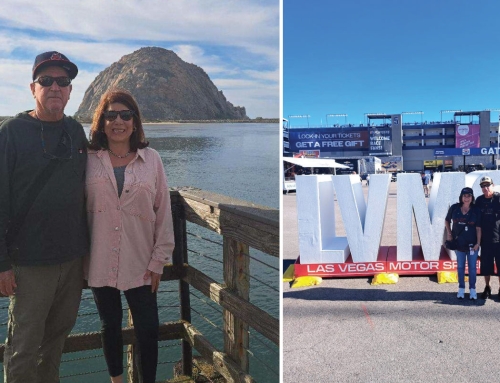
“I don’t know why every doctor wouldn’t order DCISionRT. Just order the test.”
Holly had just learned days earlier that her score was 0.8, the lowest possible, and that radiation was not recommended for her. She was still processing it when we sat down to talk.
“It made me feel relieved that it wasn’t just solely my doctor’s opinion,” Holly told me. “It was nice to have more data. Actual data to support the discussion. Scientific data.”
As a fellow DCIS survivor, I understood exactly what she meant. When you are in the midst of processing your cancer diagnosis and making decisions, having something concrete to hold onto changes things. For Holly, DCISionRT had been much like a third opinion.
“You’ve got your surgeon, you’ve got your radiation oncologist, and then you’ve got this score that’s informed by all that data.”
Holly’s path to that moment of relief was not a short one. I asked her to take me back to the beginning.
The Diagnosis
Holly is an active California mom in her 40s. She loves to take advantage of the beautiful Orange County weather by hiking and biking. Her focus on health also means that she is proactive with her medical care, especially given her strong family history of breast cancer. Her mom was diagnosed twice, and her grandmother passed away from metastatic breast cancer.
When she got a new primary care physician who took one look at that history and said a yearly mammogram wasn’t enough, Holly listened. Her doctor put her on a six-month screening protocol, alternating mammograms and MRIs. The mammogram in June 2025 was clear, but she got a call-back after her MRI in January 2026.
There was a spot they wanted to look at more closely. She went in for an ultrasound, and the radiologist was candid with her that the imaging was unclear. He offered her a choice: monitor it for another six months, or do a biopsy.
Holly didn’t hesitate. “I can’t imagine not wanting to do the biopsy,” she told him. That instinct was right. The biopsy came back as DCIS.
The Surgery Choice, and the Waiting
After her diagnosis, Holly was referred to a surgeon to discuss her options. Since the spot was small, the surgeon was pretty confident she wouldn’t need radiation afterward. After discussing her choices with the surgeon, Holly decided to do an oncoplastic lumpectomy. This surgical technique pairs two goals: cancer removal and cosmesis. As Holly shared, it was important for her to feel beautiful after DCIS.
Holly brought a scientist friend to her first consultation, someone who had helped his mother through a cancer diagnosis and knew what questions to ask. Having him in the room was, she said, really comforting.
What wasn’t comforting was the waiting. Holly was diagnosed in early February. The next available surgery date wasn’t until April 16th. That was over two months of knowing she had cancer and having to carry on as if everything was fine.
“I felt like I was just treading water, waiting and waiting. Let’s get this done. The sooner we get it done, the sooner I can get back to being me.”
In the months leading up to surgery, she continued to hike, bike, and work. But the longer she waited to get to surgery, the more her anxiety showed up, especially in her dreams. How much would the cancer grow in those two months? Her dreams were full of worry, and it was hard to get to that surgery date.
Holly’s DCIS diagnosis had come right after a year of dealing with a skin cancer diagnosis and her painful surgical recovery from that treatment. The back-to-back cancer diagnoses in her 40s hit her hard.
“It was not like the wind being taken out of my sails. It was like someone cut the sails down.”
Surgery and Recovery
Holly’s surgery date in mid-April finally arrived. During surgery, her surgeon found a second spot that hadn’t shown up on imaging. It was unsettling news, but the margins came back clear, and her surgeon was confident in the results.
Recovery has been more challenging than Holly expected. She’s grateful for her supportive friends, and especially for her teenage son, who has stepped in to do all the things she isn’t allowed to do, like reach things in the kitchen and take on the dog walking.
Holly said it was hardest to tell her son about her diagnosis. “I almost couldn’t get it out. He didn’t believe me when I said I was going to be okay. He thought I was sugar-coating it.” She continued to reassure him, and is thankful for his support.
DCISionRT: The Test She Didn’t Know About
Before Holly saw the radiation oncologist, she was chatting with a friend who told her about DCISionRT. Holly had no idea what she was talking about.
Her friend then told her all about the test. She learned how it analyzes tumor biology to generate a score that helps patients and their physicians make personalized decisions about radiation. Holly walked into her radiation oncology appointment armed with that knowledge and asked her radiation oncologist about the test.
Her score was 0.8, the lowest possible.
Her radiation oncologist confirmed that radiation was not going to benefit her. Holly now had her surgeon’s recommendation, her radiation oncologist’s recommendation, and the DCISionRT score all pointing in the same direction.
Surgery only. No radiation.
What It Means to Avoid Radiation
Holly knew how challenging radiation treatment could be. Her mom had endured 35 rounds of radiation, and the treatments and travel time were extremely hard for her parents to deal with.
“I’m relieved that I don’t have to have my life further disrupted for a treatment that could have horrible side effects, and isn’t even necessary.”
When I asked Holly what she would say to someone who was recently diagnosed with DCIS, she didn’t hesitate.
“Don’t be afraid to tell people. Talk to the people around you, because you never know who’s had a similar journey. And get the test. It’s almost like a third opinion. You’ve got your surgeon, you’ve got your radiation oncologist, and then you’ve got this score that’s informed by all that data. Not just someone’s opinion. Scientific data.”
Holly is still in early recovery, and the news that she didn’t need radiation had just arrived a few days before we talked. As we closed out our time together, she shared this:
“I’m so grateful they caught my DCIS and were able to treat it, but I’m not grateful that it happened to me.”
As a fellow DCIS patient, I can relate. As I often say:
Stage Zero doesn’t mean Zero Challenges.
Thank you, Holly, for sharing your story with us.