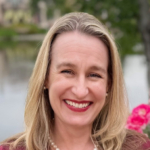
“All you heard was cancer, and the fear factor goes from 0 to 10,000.”
When Britta said that to me, I could relate.
Britta got her breast cancer diagnosis on the Friday before Thanksgiving in 2025. It was a Stage 1 invasive ductal carcinoma (IDC). She was 56, and the first thing she thought about was that her kids weren’t married yet and she didn’t have grandchildren.
The emotional impact of breast cancer was something that surprised her, especially since she works in the medical field. Britta and her husband have a facial plastic and med spa practice in Salt Lake City.
He’s a surgeon, and they know a lot of doctors.
She told me she thought all of that would make what came next easier.
It didn’t.
The Lump That Didn’t Look Like Cancer
She never skips a medical appointment. “When they say you don’t have to come for another two years, I say, no, no, I’ll be here next year,” she told me.
Britta’s regularly scheduled mammogram in February 2025 came back clean. She doesn’t have a family history of cancer, and the women in her family live into their 90s. She does her self-exams anyway.
In the first week of October, she found a lump in her lower left breast. It was hard, close to the size of a walnut. She’d had a calcium deposit years earlier and assumed that was what this was.
She called her physician and was sent to Huntsman Cancer Center for an MRI and an ultrasound. While she was on the table, the technicians came back two or three times with the same question from the radiologist. Had she been in a car accident? Had she hit her chest on a steering wheel?
To the radiologist, it was inconclusive. It may have been fatty tissue from an injury.
“They couldn’t even tell that it was cancer,” she said.
Then she was given a choice. They could wait and see whether it grew, or they could biopsy it.
“Nope, I want to know. So we’re doing a biopsy.”
The Phone Call
Her husband was walking from the operating room to their office when she got the call. It was breast cancer. As the doctor shared the news with both of them on speakerphone, her husband got pale. Then he sprang into action and texted everyone he knew.
One name kept coming up in the conversations: Dr. Matsen. Before long, they were in her office, carefully reviewing the treatment options. It was a lot of information to absorb, but the discussion helped Britta and her family understand their choices. They left that appointment with a surgery date already on the calendar for January 13.
Everyone Had an Opinion
Once the diagnosis was real, the advice started, and most of it pointed the same way. Doctor after doctor told her to have a mastectomy.
“Britta, we hate radiation,” her friends in reconstruction told her. “I kept hearing from so many plastic surgeons, have a mastectomy, it’s more reconstructable, have a mastectomy.”
The words were kind and almost nonchalant, and that was difficult to hear.
“I just could not wrap my head around not having a body part when I woke up from surgery.” Britta wanted a lumpectomy, but the fact that she had breast implants added a potential complication. Whole breast radiation after a lumpectomy could damage the implants.
She decided on a lumpectomy, and if something was discovered in her lymph nodes that wasn’t expected, a mastectomy was still an option. “Do the small surgery, and then do a bigger surgery if you have to.”
Later in our conversation, she came back to how overwhelming it all was.
“I thought, having a physician as a husband would make it easier to navigate your cancer journey, but it didn’t make it easier. He was as overwhelmed as I was.”
The surgery decision had been made, but what about radiation?
The Test She Found Through a Neighbor
Britta didn’t learn about AidaBreast® from her medical team. Instead, she found out through a former neighbor who had worked at PreludeDx.
“The world is so small,” she said.
That connection led to conversations with PreludeDx’s team and a radiation oncologist who took the time to explain her diagnosis, treatment options, and how AidaBreast could provide additional insight into whether radiation would benefit her. She was grateful to have the opportunity to run the test on the tissue from her original biopsy, with no additional procedure required.
A week before her surgery, Dr. Whitworth called to review her AidaBreast results with Britta and her husband.
“I really didn’t need radiation, honestly, based on the Aida results,” she told me.
Her Decision Score was 3.8, on a scale that runs from 0 to 10. The report gave her 10-year invasive locoregional recurrence risk two ways, depending on what she did after surgery.
With a lumpectomy and endocrine therapy, her 10-year risk of recurrence was 7%. If she added radiation treatment, her risk lowered to 4%.
“So very, very low,” she said.
With those results in hand, Britta chose to proceed with the lumpectomy a week later, and wait to see what the testing on her lymph nodes revealed.
Surgery, Results, and Why She Chose Radiation
Britta headed into her lumpectomy with more fear of what the results might mean than of the actual procedure.
“I’m in a surgical world, so surgery didn’t scare me,” she said. “What scared me was making sure you got all the margins.”
Fortunately, her surgery confirmed what she had hoped for: clean margins and no cancer in her lymph nodes.
With that good news, along with her AidaBreast results showing she was already at low risk but could still benefit from radiation, Britta’s physicians were able to recommend targeted, partial-breast radiation instead of whole-breast radiation.
That distinction mattered. Whole-breast radiation carried greater concerns for her implants and surrounding skin, while partial-breast radiation offered a more focused approach.
“I think knowing that I could do partial breast radiation was key,” she said.
With the additional insight from AidaBreast and guidance from her physicians, Britta chose to move forward with radiation to further reduce her risk of recurrence. Her risk was already low, but as she put it, “Why not lower my percent just a little bit more?”
She completed 10 sessions of partial-breast radiation in late March 2026—confident she had chosen the treatment that was right for her.
Britta reflected that the hardest part was not the radiation treatment itself, but the decisions and uncertainty that came before it. Choosing the right treatment path was an emotional process, and having the AidaBreast report helped provide clarity and confidence as she weighed her options.
“Having that information in my hands was incredibly helpful,” she said. “It gave me reassurance that I was making the right decision for me.”
Looking Ahead
As we closed out our time together, I asked Britta for some words of encouragement she might share with a newly diagnosed breast cancer patient.
“Get as much information and data as you can about your cancer tumor. I mean, the more information you can have, the better you can make decisions.”
She was grateful for the layers of support around her, at work and at home. Her practice manager and her colleagues, her two sons, and her husband, “just my superhero.”
Now that radiation is behind her, she’s looking forward to spending more time with family.
Encouraging and supporting a wider breast cancer community
As she continues in her survivorship journey, she’s also planning to educate and support the wider breast cancer community in the fall of 2026 with a campaign called “Too Hot for Cancer.”
The name came out of a conversation she had with her husband after leaving the cancer center, when he looked right at her and said, “Look at you, you’re just too hot for cancer.” Those words stuck.
Then she described the women she saw at the cancer center. Every one of them, she said, was too hot for cancer.
Her vision for the campaign is more than helping women feel beautiful during treatment. She shared, “If we touch one woman and it makes her have a mammogram, or not ignore the lump that she found, then I would say the whole campaign’s worth it.”
Thank you, Britta, for sharing your breast cancer story with us!