Blog
In this webinar, Eric Brown, MD, FACS; Erica Giblin, MD; James V. Pellicane, MD; Troy Bremer, PhD; and Leona Hamrick, DHSc, PA-C, MSL-BC, discuss how DCISionRT and its newly integrated Residual Risk Subtype (RRt) played a significant role in treatment decision making in DCIS patients identified in the RRt category. These key opinion leaders discuss actual patient cases with RRt, the differentiating factors among cases, patient preference and final treatment decisions.
“I send every qualified patient I see with ductal carcinoma in situ (#DCIS) for the #DCISionRT test, even the ones with a tiny low-grade lesion, because sometimes the test reveals an elevated risk recurrence score, which is surprising. And I never want to miss offering radiation modality options to patients who will benefit. I have seen the greatest decision impact on those women who were not inclined to undergo radiation but when their DCISion score is high, they choose to proceed with radiation.”
“My Decision Score was 6.2, which is considered elevated. My 10-year total risk of recurrence (DCIS + invasive) was 22% with breast conserving surgery alone and 5% with breast conserving surgery plus radiation. I felt a lot more confident moving forward with RT knowing the decision was based on my personal tumor biology. I have 100% peace of mind with these test results.”
“My biggest advice for other women diagnosed with DCIS is to slow down long enough to research and truly understand your options. You have time for a second opinion. You have time for genetic testing. You have time for the DCISionRT molecular test. You must be your own advocate, make sure your opinions are heard, and not be overly pressured to just go along with the doctor’s recommendation.”
“I encourage women to get as much information as you can before deciding on your DCIS treatment. It is your health and your body, so you don’t want to go overboard with treatments, especially radiation, if you don’t have to.”
“My advice for other women is to do your homework and don’t be afraid to ask for a second opinion. If I had not taken an active role, I would have lost my right breast, which was not the right decision for me.”
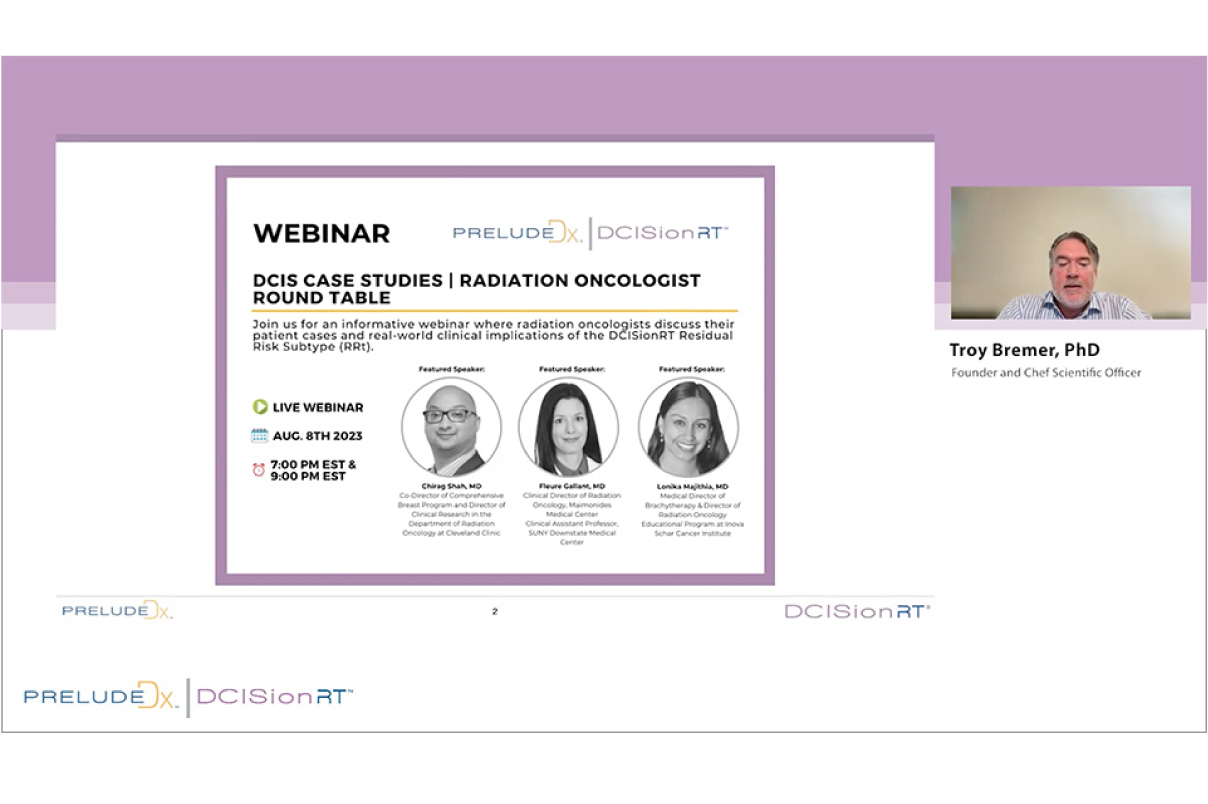
In this webinar, Chirag Shah, MD; Fleure Gallant, MD; Lonika Majithia, MD; Leona Hamrick, DHSc, PA-C, MSL-BC; and Troy Bremer, PhD, discuss how DCISionRT and its newly integrated Residual Risk Subtype (RRt) played a significant role in treatment decision making in DCIS patients identified in the RRt category.
“My advice for other doctors is use DCISionRT to help make a better, more informed decision with the DCIS patient. DCISionRT is a great tool that we have at our disposal to evaluate radiation therapy benefit and risk recurrence following breast conserving surgery, and the ongoing studies are going to be game changing.”
“My Decision Score was a 9.2 out of 10, which is quite high. The test showed that my total risk (DCIS + invasive) of recurrence over the next 10 years was 42% without radiation and 15% with radiation. So, I am very happy that I am doing the right thing. And my doctor was impressed with the test and will be using it for other patients.”
“For DCIS patients we don’t want to treat and subject patients to the side effects of radiation if the risk benefit ratio is low. That is why I am really excited about DCISionRT. DCISionRT is a risk assessment tool that looks at the patient’s tumor biology to determine an individual patient’s benefit of radiation therapy following breast conserving surgery, as well as the patient’s risk of DCIS recurring or progressing to invasive cancer.”